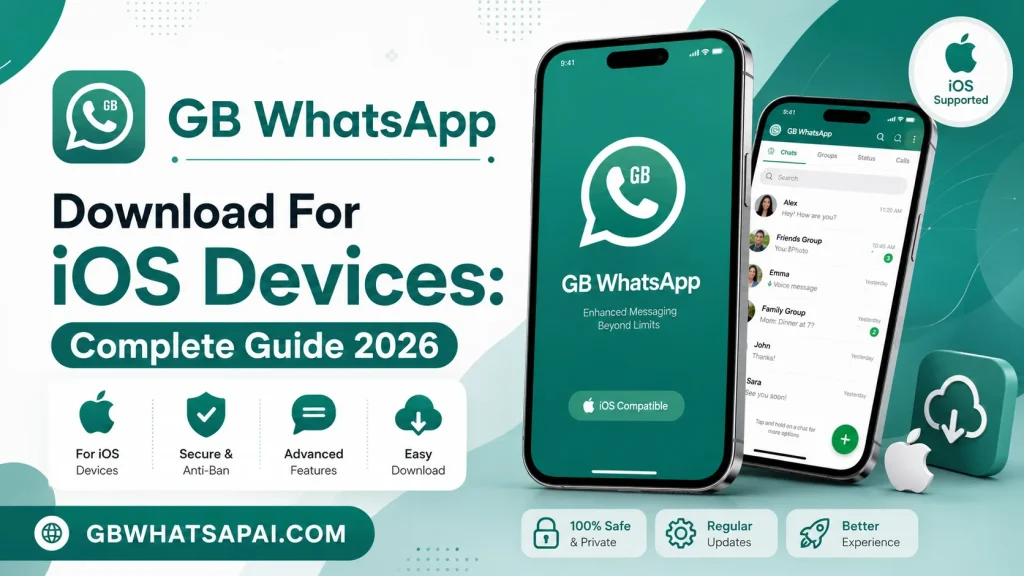
GB WhatsApp Download For iOS Devices: Complete Guide 2026
iPhone users frequently search for a way to get the same customization found on Android through GB WhatsApp. This guide from GBWHATSAPAI.COM explains why the process works differently on iOS, what options actually exist, and how to approach each one safely. Every method below is broken down step by step so the differences between platforms are easy to follow.
Why GB WhatsApp Works Differently On iOS
Apple’s operating system uses a closed distribution model, meaning every app installed through the standard App Store goes through a strict review process. GB WhatsApp is a modified app that does not meet Apple’s guidelines, so it is not available through the official App Store. This is the main reason iPhone users cannot install it the same way Android users do.
Android, by contrast, allows APK files to be installed directly from outside its app store with a simple settings toggle. iOS restricts this kind of installation unless specific developer or enterprise tools are used. Understanding this difference from the start makes it much easier to choose the right approach for an iPhone or iPad.
App Information Overview
A quick look at the basic specifications helps set realistic expectations before choosing an installation method. The table below summarizes what most iOS users want to know upfront.
| Detail | Information |
|---|---|
| App Type | Modified messaging application, originally built for Android |
| Native iOS Version | Not available through the App Store |
| Distribution Format | Signed IPA file or marketplace listing |
| Account Requirement | Active phone number |
| Certificate Dependency | Yes, for most sideloading methods |
| Update Handling | Varies by installation method |
| Compatibility | Most iOS versions, subject to specific app updates |
These details make it easier to compare the trade-offs between the five methods covered later in this guide. Certificate dependency in particular is worth remembering, since it affects long-term reliability more than any other factor on iOS.
Android GB WhatsApp Versus iOS Installation
The core app experience stays largely the same once installed, but getting there looks very different across the two platforms. On Android, a downloaded APK file installs directly after a single permission toggle in the system settings. On iOS, the same result requires trusting a signed certificate or going through an alternative marketplace, since Apple does not allow direct APK-style installation.
| Aspect | Android | iOS |
|---|---|---|
| Installation Format | APK | Signed IPA or marketplace listing |
| Direct Sideloading | Yes, through settings toggle | No, requires certificate trust |
| Update Process | Manual APK reinstall | Marketplace, signing service, or manual reinstall |
| Long-Term Stability | High | Depends on certificate status |
| Jailbreak Requirement | Not applicable | Not required for current methods |
This comparison explains why iOS guides read differently from Android guides for the same app. The underlying features stay consistent, but the path to get there depends entirely on which operating system is involved.
Available Methods For iOS Devices
A handful of practical paths exist for iPhone and iPad users who want a similar experience to the Android version. Each comes with its own setup process, limitations, and level of technical involvement. The sections below walk through every option currently used by iOS-focused communities.
- Third-Party App Signing Services: Install a modified IPA file through a signing certificate.
- Alternative App Marketplaces: Use a sideloading store built for non-App Store apps.
- Enterprise Certificate Installation: Trust a developer profile that distributes the app directly.
- Cloud-Based Android Access: Run an Android environment remotely and control it from an iPhone browser.
- Dual Messaging Apps: Use two official WhatsApp accounts through Apple’s built-in dual SIM or second-line features.
Method 1: Using A Third-Party App Signing Service
App signing services re-sign an IPA file with a valid certificate so iOS accepts it as a trusted installation. This is currently the most common way iPhone users get access to modified apps outside the App Store. The certificate used typically needs periodic renewal to keep the app functioning.
Step-By-Step Signing Service Installation
- Choose a signing service compatible with modified messaging apps.
- Create an account and select the IPA file for installation.
- Follow the on-screen prompt to begin the signing and installation process.
- Open the Settings app once installation finishes and navigate to the profile management section.
- Trust the new developer profile associated with the installed app.
- Return to the Home Screen and open the newly installed app icon.
- Complete verification with an active phone number.
- Restore a backup if one exists, or begin a fresh chat setup.
Certificates used by these services sometimes get revoked by Apple, which causes the app to stop opening until it is re-signed. Keeping the signing service’s account details handy makes this process quicker the second time around. Renewal frequency varies depending on the certificate type used by the specific service.
Choosing A Reliable Signing Service
Not every signing service offers the same level of consistency, so a bit of research beforehand pays off. Services that maintain multiple certificate types tend to recover faster from a revocation than those relying on a single certificate for all users. Checking recent user feedback within community spaces gives a reasonable sense of how often a particular service experiences downtime.
Free signing services usually come with slower re-signing turnaround and stricter limits on how many devices can use one certificate. Paid tiers often prioritize faster certificate replacement and support more simultaneous installs. Weighing cost against how critical uninterrupted access is helps decide which tier makes sense for a given user.
Method 2: Using An Alternative App Marketplace
Several independent marketplaces exist specifically for iOS apps that fall outside Apple’s official catalog. These marketplaces function similarly to an app store but require a one-time trust setup before anything can be installed. Once configured, updates can often be managed from within the marketplace app itself.
Step-By-Step Marketplace Installation
- Download the marketplace app’s installer profile through Safari.
- Install the configuration profile from the Settings app.
- Open the marketplace app once it appears on the Home Screen.
- Search for the modified messaging app within the marketplace catalog.
- Tap install and wait for the download to finish.
- Trust the developer certificate tied to the newly installed app.
- Launch the app and complete phone number verification.
- Adjust notification permissions from the iOS Settings app.
Marketplace-based installations tend to be more convenient for future updates since the same app handles new versions automatically. This removes the need to repeat the entire signing process every time an update becomes available. Storage space should still be checked beforehand, since some marketplace apps also install their own background management tool.
Method 3: Using An Enterprise Certificate Installation
Enterprise certificates were originally designed for internal company app distribution but are sometimes used to distribute modified apps outside the App Store. This method installs the app directly through a downloadable link rather than through a marketplace interface. It works similarly to the signing service method but skips the account creation step.
Step-By-Step Enterprise Installation
- Open the installation page for the modified app on the iPhone’s browser.
- Tap the install button and confirm the download prompt.
- Open Settings and navigate to the General section.
- Select the VPN and Device Management option to find the new profile.
- Trust the enterprise developer associated with the app.
- Return to the Home Screen and launch the app icon.
- Enter a phone number to begin verification.
- Complete setup by restoring a backup or starting fresh.
Enterprise certificates are more prone to sudden revocation than dedicated signing services, since Apple periodically audits and blocks certificates used outside their intended purpose. When this happens, the app displays an “Untrusted Enterprise Developer” message until a new certificate becomes available. Checking community update channels regularly helps catch these revocations early.
Method 4: Using Cloud-Based Android Access
Cloud-based Android services let an iPhone connect to a remote Android environment through a browser or dedicated app. This effectively runs a full Android system on distant hardware while streaming the display back to the iPhone screen. Since the environment is genuinely Android, the modified app installs and runs exactly as it would on a physical Android device.
Step-By-Step Cloud Access Setup
- Create an account with a cloud-based Android service.
- Launch a new virtual Android session from the service’s dashboard.
- Open the built-in browser or file manager inside that session.
- Download the modified app’s APK file within the virtual environment.
- Install the APK using the same steps as a physical Android device.
- Complete phone verification inside the remote session.
- Access the session anytime through the iPhone browser or companion app.
This method avoids the certificate trust and revocation issues tied to the other three options entirely. The trade-off is a recurring subscription cost for most cloud Android providers, along with a dependency on a stable internet connection for every session. Latency can also be noticeable on slower networks, making fast typing feel slightly delayed.
Method 5: Dual Messaging Through Apple’s Built-In Features
For users who mainly want two active messaging accounts rather than the extended customization features, Apple’s own dual number tools offer a simpler path. Modern iPhones support a second phone line either through a physical second SIM or an eSIM profile. This allows the official WhatsApp app to run two separate accounts without any sideloading involved.
Step-By-Step Dual Number Setup
- Add a second phone number through the Settings app’s Cellular section.
- Choose between a physical second SIM or an eSIM, depending on carrier support.
- Install the official WhatsApp app if it is not already present.
- Register the second account using the newly added phone number.
- Switch between accounts as needed directly within the app or through separate profiles.
This method avoids every certificate and marketplace concern that comes with modified apps, since only the official app is involved. It does not, however, provide access to the extended customization features that draw people toward the modified version in the first place. It remains the most stable and Apple-approved option for anyone who only needs a second account.
Comparison Table Of iOS Methods
| Method | Setup Difficulty | Update Reliability | Certificate Risk | Best For |
|---|---|---|---|---|
| Signing Service | Moderate | Manual renewal needed | Moderate | Users comfortable with periodic re-signing |
| Alternative Marketplace | Easy to Moderate | Handled within the app | Moderate | Users wanting simpler updates |
| Enterprise Certificate | Moderate | Manual, less predictable | High | Users following active community links |
| Cloud-Based Android | Easy | Same as native Android | None | Users wanting the full Android experience |
| Dual Number (Official App) | Easy | Standard App Store updates | None | Users who only need a second account |
Each row highlights a different trade-off between convenience, stability, and how close the result comes to the full customization found on Android. Cloud-based access offers the most reliable long-term experience since it runs genuine Android software rather than a signed iOS package. Signing services and enterprise certificates remain popular because they keep everything running natively on the device itself.
Backing Up Chats Before Switching Methods
Protecting existing conversations matters just as much on iOS as it does on any other platform. A backup should always be created before installing a new method or switching between different signing services. Skipping this step risks losing message history if a certificate gets revoked unexpectedly.
- Open the messaging app’s settings and locate the backup option.
- Choose a backup destination such as iCloud or local device storage.
- Confirm the backup completes fully before making any changes.
- Store a copy of the backup file separately if switching between installation methods.
Once a backup exists, restoring it after reinstalling the app is usually a quick process handled automatically during the verification step. Keeping backups current on a weekly basis reduces the risk of losing recent conversations during a certificate issue.
Certificate Trust And Revocation Explained
Every non-App Store installation method on iOS relies on some form of developer trust, and Apple periodically revokes certificates that violate its distribution terms. When a certificate is revoked, the affected app stops opening and displays a trust warning instead. This is one of the most common frustrations reported by iOS users of modified apps.
Re-signing the app through the same service, marketplace, or an alternative provider typically resolves the issue within a short period. Some users maintain accounts with more than one signing service specifically to have a backup option ready. Community forums and update channels tend to report revocations quickly, which helps users react before losing access for too long.
Safety Tips For iOS Sideloading
Trusting an unfamiliar developer profile carries more risk than installing directly through Apple’s reviewed App Store. A few precautions reduce that risk significantly without adding much extra effort.
- Only trust developer profiles tied to a specific, intentional installation.
- Remove old or unused developer profiles from the Settings app periodically.
- Avoid entering sensitive account credentials into unfamiliar marketplace apps.
- Keep the iOS version updated to benefit from the latest security patches.
- Research a signing service or marketplace’s reputation before committing to it.
Reviewing installed profiles every few months through the General settings menu is a good habit for any iPhone running sideloaded software. Removing profiles no longer in active use also frees up a small amount of system overhead.
Common Installation Issues And Fixes
| Issue | Likely Cause | Suggested Fix |
|---|---|---|
| “Untrusted Developer” Message | Profile not yet trusted | Trust the profile in Settings under Device Management |
| App Icon Disappears After Update | Certificate revoked | Re-sign or reinstall through the same service |
| Verification Code Not Arriving | Carrier or network delay | Request call verification instead of SMS |
| App Crashes On Launch | Incompatible iOS version | Check the app’s supported iOS version range |
| Marketplace App Won’t Open | Expired configuration profile | Reinstall the marketplace’s profile from Settings |
Most of these issues resolve with a straightforward re-trust or reinstall step rather than requiring a full device reset. Persistent problems across multiple methods usually point toward an outdated iOS version that needs updating first.
Updating GB WhatsApp On iOS
Update steps vary slightly depending on which method was used for the original installation. Marketplace-based installs typically handle updates automatically within the marketplace app itself. Signing service and enterprise certificate installs usually require downloading a new IPA file and repeating the trust process.
- Check the installation source for a newer version notice.
- Download the updated IPA or marketplace listing.
- Reinstall over the existing app, keeping the same developer profile if possible.
- Confirm chat history and settings carried over correctly after the update.
Setting a recurring reminder to check for updates every few weeks helps avoid running an outdated build with unresolved bugs. Marketplace apps that support in-app update notifications remove most of the guesswork from this process.
Data Privacy Considerations On iOS
Sideloading any app on iOS means granting a level of trust that the App Store review process normally handles automatically. Marketplace apps and signing services can technically see which apps get installed through their platform, so choosing a reputable provider matters more than it might seem. Reading through a service’s stated privacy practices before committing an account to it is a reasonable precaution.
Chat backups stored in iCloud should use a strong, unique Apple ID password along with two-factor authentication enabled. Local backups kept on the device itself benefit from the same passcode or Face ID protection already covering the rest of the phone. Removing unused developer profiles, as mentioned earlier, also limits the number of third parties with any ongoing access to the device.
Frequently Asked Questions
Why isn’t GB WhatsApp available directly on the App Store? Apple’s review guidelines do not permit modified versions of existing apps, so it can only be installed through sideloading methods.
Is a jailbreak required to install a modified messaging app on iPhone? No, most current methods work on a standard, non-jailbroken iPhone through signing services, marketplaces, or enterprise certificates.
Will installing a modified app affect the official WhatsApp account? No, the two apps use separate installations and do not interfere with each other unless the same number is registered on both without proper account linking.
How often do certificates get revoked? Revocation timing varies and cannot be predicted precisely, though active signing services typically re-issue certificates fairly quickly after a revocation.
Can chat backups be restored after reinstalling through a different method? Yes, as long as the backup file was saved beforehand, it can usually be restored during the verification step of the new installation.
Is the cloud-based Android method free to use? Most cloud-based Android services require a subscription, though some offer limited free trial sessions for new users.
Does the dual number method give access to the same customization features? No, dual number setups only work with the official app, so extended themes and privacy toggles from the modified version are not included.
What happens if a marketplace app itself gets removed from the device? Reinstalling the marketplace’s configuration profile and trusting it again typically restores access without affecting existing chat data.
Can an iPad use the same installation methods as an iPhone? Yes, all five methods described in this guide work the same way on iPadOS, since it shares the same certificate and profile system as iOS.
Does switching Wi-Fi networks affect an already-installed sideloaded app? No, once installed and trusted, the app continues working across different networks the same way any other app does.
Conclusion
Installing GB WhatsApp on an iPhone takes a different route than it does on Android, mainly due to how Apple manages app distribution. Signing services, alternative marketplaces, enterprise certificates, and cloud-based Android access each offer a workable path depending on how much reliability and customization matters most. GBWHATSAPAI.COM continues to track which of these methods stays stable so iOS users have an accurate reference point when certificates change or new signing options appear.